
Rockdale County Arrest Records and Charges
Rockdale County arrest records are created on the law-enforcement and jail side when a person is taken into custody. They may connect to the arresting agency, booking date, custody status, bond, and booking charge. The court charge record begins when the criminal justice process moves into Magistrate, State, or Superior Court. At that stage, the key question is not just what appeared at booking, but what charge the prosecutor filed, amended, reduced, dismissed, or resolved.
The booking side and the court side should not be merged. Jail records may show a person in custody or recently booked, while the court file tracks the formal charges and outcome. For custody and jail lookup details, use Rockdale County inmate records. For the full criminal case file, including disposition and sentence, use Rockdale County criminal court records.
The Tyler Rockdale Jail Records portal is the official jail-search source linked by the Sheriff's Office.
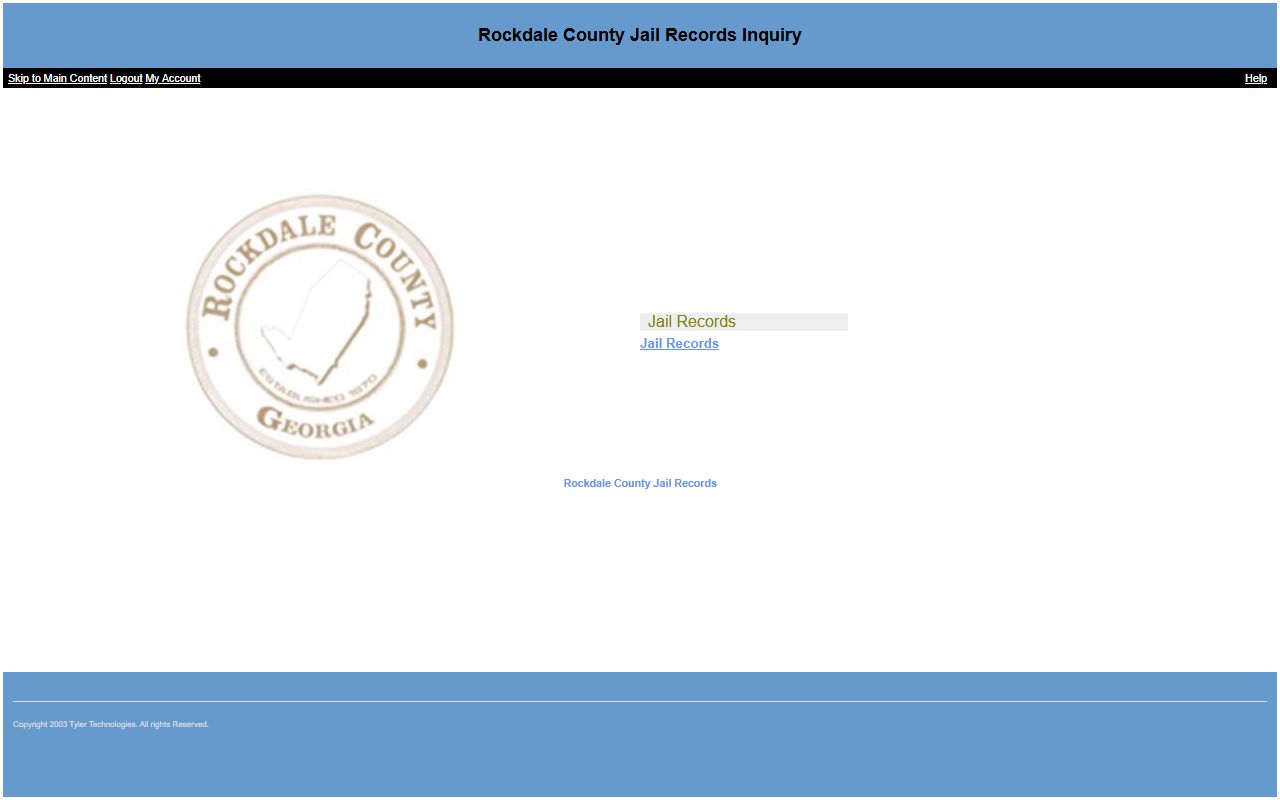
The jail portal is useful for the arrest and booking side, but it should not be treated as proof that a filed court charge ended in conviction.
Arrest Records to Court Charges
The arrest-to-charges pathway in Rockdale County can involve the Sheriff's Office, Magistrate Court, the District Attorney, the Clerk of Superior and State Courts, and the trial court that receives the case. Magistrate Court is important early because it handles warrant applications, arrest and search warrants, first appearance, bond, and probable cause. State Court handles misdemeanors and traffic. Superior Court handles felony prosecutions.
The District Attorney's Office is central once formal prosecution decisions are made. The official DA site names Alisha A. Johnson as District Attorney, and the county page states that the DA represents the State and Rockdale County in criminal prosecutions. The DA case-status source directs people to the Clerk of Superior and State Court at 770-278-7900 or the DA at 770-278-7990 for case status and appearances.
- An arrest or warrant event creates law-enforcement and booking records.
- Magistrate Court may handle first appearance, bond, and probable-cause events within the early case window.
- The prosecutor reviews the matter and decides what charge to file, reduce, amend, or decline.
- State Court receives many misdemeanor charges, while Superior Court receives felony charges.
- The clerk's case file then tracks charge status, plea, docket events, disposition, sentence, and financial obligations.
Rockdale County First Appearance Charges
First appearance is the early court event that often follows an arrest. Rockdale research says inmates must have a first appearance within 72 hours of arrest. The Magistrate calendar and Sheriff's first appearance page describe hearing schedules, though they do not match in every detail. The safe reading is that Magistrate and Sheriff schedules should be checked for the current week before a person relies on a stored schedule.
Magistrate Court can issue warrants and hear warrant applications, but it is not the final source for every filed criminal charge. A first appearance may show bond, probable cause, and next-step routing. The later State or Superior Court file is where the formal charge, plea, disposition, and sentence are tracked.
The Sheriff's Judicial Services page describes courthouse security, civil process, and the Civil and Warrants Department.
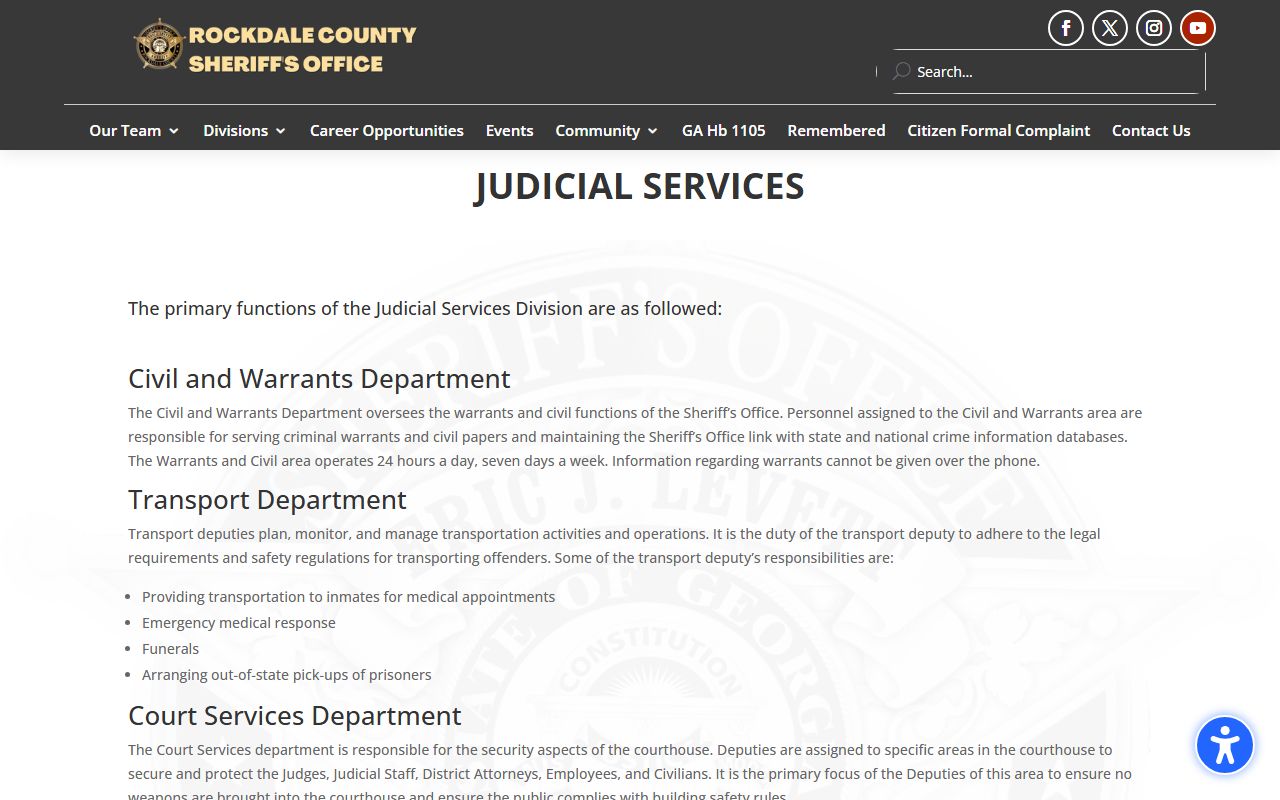
Judicial Services is part of the arrest-to-court path because warrants, courthouse security, and court-related service work can connect jail events to docket events.
Charging Documents After Arrest
Charges after arrest are usually formalized through a court document. In Rockdale County research, the clearest local terms are indictment and accusation, with warrants and citations also appearing as entry points. A felony may be charged by indictment. State Court misdemeanor charges often use accusation-style filings. A complaint or citation can initiate or describe lower-level matters, but the final charge status must be checked in the court record.
| Document | Who Uses It | What It Does | Rockdale Context |
|---|---|---|---|
| Complaint or citation | Law enforcement or court process | States the alleged offense or initiates a lower-level case | Commonly tied to traffic, ordinance, or initial arrest paperwork. |
| Accusation | Prosecutor | Formally files a charge without a grand-jury indictment | Often associated with State Court misdemeanor prosecution. |
| Indictment | Grand jury through prosecution | Charges felony offenses for Superior Court prosecution | Relevant to Superior Court felony criminal files. |
Rockdale County Charge Status
Charge status can change many times between arrest and disposition. A booking charge may be replaced by a filed charge. A filed charge may be amended, reduced, dismissed, or marked nolle prosequi. One arrest can also lead to several separate counts, and each count can resolve in a different way. Read charge status by count, not just by the first charge line.
| Status | What It Means |
|---|---|
| Pending | The charge remains open or unresolved in the court record. |
| Amended | The prosecutor or court record changed the charge language, count, level, or statute reference. |
| Reduced | The charge moved to a lesser offense or lower severity as part of case handling or plea resolution. |
| Dismissed | The court no longer proceeds on that charge, though the case record may still show the history. |
| Nolle prosequi | The prosecutor declines to pursue that charge further, subject to the legal effect of the case order. |
| Disposition entered | The court has recorded the final outcome of that charge. |
Find Rockdale County Charge Records
Use more than one source when tracking charges after arrest. The jail search can show booking and custody information. re:SearchGA is the forward-looking court-record path after the clerk's 2026 notice ending Tyler Public Access support. The Clerk of Superior and State Courts is the source for certified dispositions, older Superior criminal records, and copy requests. The DA may be needed for case status, bench-warrant direction, and record restriction after newer arrests.
The Sheriff's Open Records page covers law-enforcement record requests, fees, and request channels.
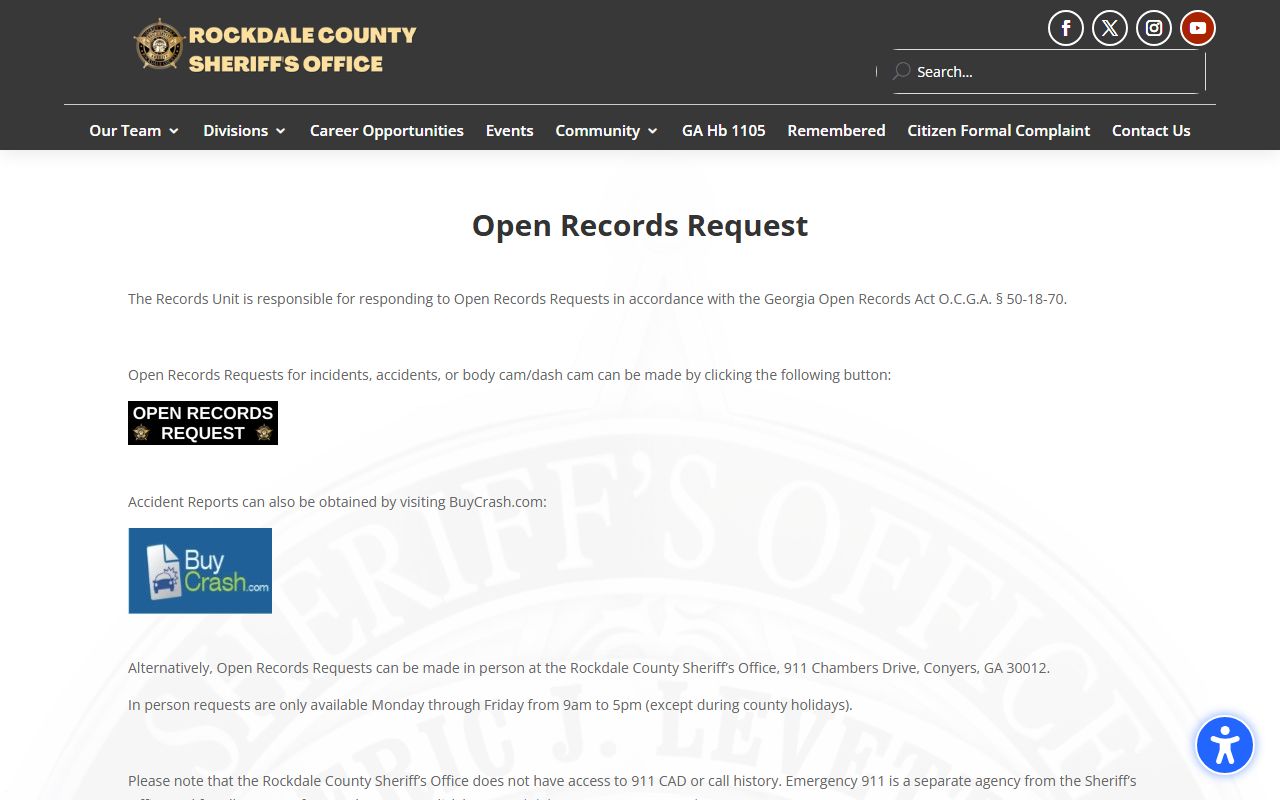
Sheriff records requests are appropriate for law-enforcement materials, but court charge status and certified dispositions still belong with the court or clerk.
The Sheriff's contact page lists the main office, jail, courthouse, anonymous tip, non-emergency, bonding, and community policing numbers.
Use the listed contacts by function: jail for custody, bonding for bond issues, court or clerk for filed charge status, and open records for law-enforcement copies.
Charges vs. Convictions
A charge is an allegation. A conviction is a final guilty outcome by plea, verdict, or judgment. Rockdale County arrest records and booking charges should not be read as convictions. Court charge records can also show charges that were filed but later amended, reduced, dismissed, or resolved without a conviction.
| Point | Charge | Conviction |
|---|---|---|
| Meaning | An alleged offense listed at booking or filed in court | A final guilty adjudication or plea outcome |
| Timing | Before final judgment | After plea, verdict, or court finding |
| Can change | May be amended, reduced, dropped, or dismissed | Changes only through appeal, restriction, court order, or other legal process |
| Record reading | Check each count and status | Check disposition and sentence for each count |
Restricted Arrest Records and Charges
Georgia law limits public access to some records. Juvenile files usually require a court order except for limited statutory public categories. Adoption records, mental-health proceedings, sealed matters, restricted criminal-history entries, Social Security numbers, financial account details, medical information, and minor names may be redacted or withheld. Death certificate details are restricted in vital-record systems, which shows the broader privacy approach used across official records.
For criminal-history restriction, GBI says O.C.G.A. 35-3-37 governs eligible records. For arrests after July 1, 2013, the person contacts the prosecutor rather than applying through GBI. For older arrests, the person may need the arresting agency. In Rockdale, that can mean the DA for newer prosecution decisions, the Sheriff's Office for agency records, and the Clerk of Superior and State Courts for certified court dispositions.
| Record Type | Public Access Concern | Likely Source |
|---|---|---|
| Juvenile charge | Georgia juvenile file limits | Juvenile Court and court order process |
| Restricted arrest | Eligibility under O.C.G.A. 35-3-37 | DA or arresting agency based on arrest date |
| Certified disposition | Needed to prove final court outcome | Clerk of Superior and State Courts |
| Law-enforcement report | Open-records exemptions or redactions | Sheriff's Open Records channel |
Note: Eligibility for restriction depends on charge outcome, conviction status, arrest date, and Georgia law.
Rockdale County Charge Contacts
Use the office that owns the record. Jail booking and custody questions start with the jail or Sheriff's Office. Filed Superior and State Court charge records route through the Clerk of Superior and State Courts. Prosecution status, bench-warrant direction, and record-restriction decisions can involve the District Attorney. Magistrate Court handles first appearance, bond, probable cause, and warrant applications, but it does not replace the later felony or misdemeanor case file.
Rockdale County District Attorney
922 Court Street NE, Suite/Room 201
Conyers, GA 30012
770-278-7990
Rockdale County Sheriff's Office
911 Chambers Drive NW
Conyers, GA 30012
770-278-8000